Vows, Prices, Bans, and a Whole Lot of Shekels

Daily Reading: Leviticus 27 (KJV)

Leviticus 27 is the grand finale of the book, and it reads like God handed Moses a price list longer than a hardware store receipt. Make a vow? Here’s the menu: fifty shekels for a prime-age man, thirty for a woman, twenty for a boy, ten for a girl. Babies get five if it’s a boy and three if it’s a girl. Animals get appraised by the priest. Houses get valued with a fifth added if you redeem. Land gets the same deal based on how many years till jubilee. And the firstborn already belong to God, so you can’t even vow those away. Devote something under the ban? Tough luck, it’s most holy and stays gone forever. Mess up the math or try to cheat the system? You’re in deep trouble with the priest and the Lord.

You can almost picture some poor Israelite scratching his head: “Wait, Lord, if I vow my ox and then my donkey, do I get a discount? And what if the ox kicks the priest during appraisal?” It’s complicated, precise, expensive, and zero room for error. The Law dispensation demanded exactness because man’s heart is sneaky and sin loves loopholes.

But praise God we’re not under that price-tag system anymore. In the church age, the price for our redemption wasn’t figured by age, gender, or market value—it was paid once, fully, perfectly by the blood of Jesus Christ. No shekels, no appraisals, no added fifths, no bans we can’t escape. “Forasmuch as ye know that ye were not redeemed with corruptible things, as silver and gold… but with the precious blood of Christ, as of a lamb without blemish and without spot” (1 Peter 1:18-19 KJV). One sacrifice, one payment, eternal results. No fine print. No priest haggling over your worth.

So the next time life feels like you’re trying to calculate your way out of trouble, remember: the old system had a thousand rules to remind us we couldn’t pay. The new system has one answer—Christ already paid it all. Rest in that, and quit trying to bargain with the One who bought you outright.

Keep reading, Numbers opens with God counting heads and organizing an army—things are about to get moving in the wilderness.

Until tomorrow, stay in the Book. 📖
Brother Tony
The Cost of Walking — or Not Walking — in His Statutes

Daily Reading: Leviticus 25–26 (KJV)

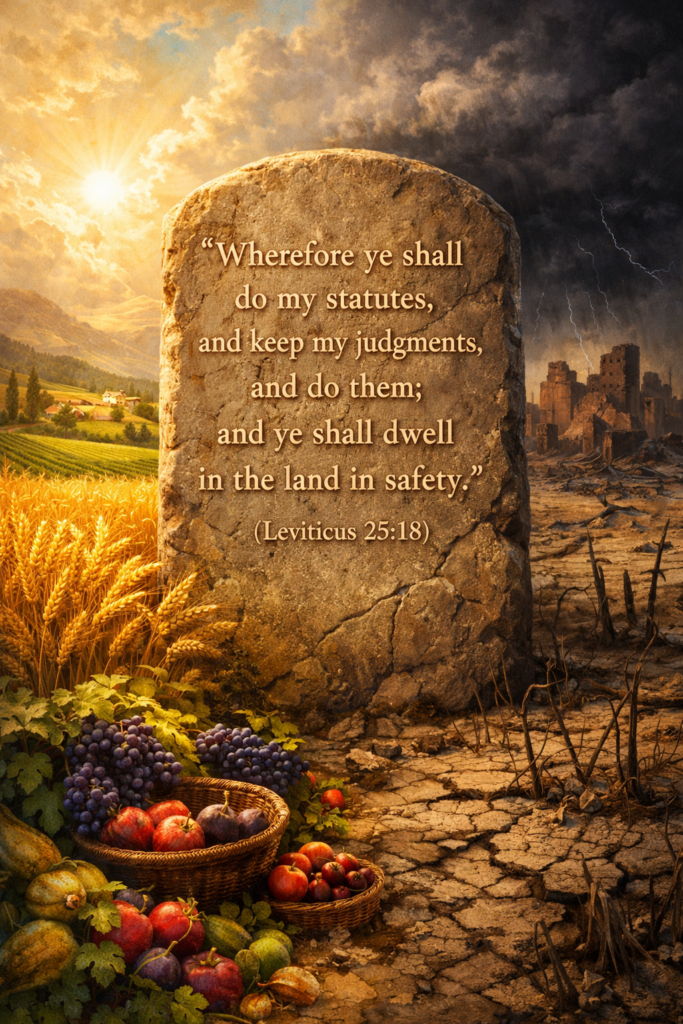
Leviticus 25:18 “Wherefore ye shall do my statutes, and keep my judgments, and do them; and ye shall dwell in the land in safety.”

The promise is wonderfully clear and direct: Walk in God’s statutes. Keep His judgments. Do them.

Then the result is safety, provision, and rest.

The passage immediately shows what obedience produces in everyday life: Leviticus 25:19 — “And the land shall yield her fruit, and ye shall eat your fill, and dwell therein in safety.” Leviticus 25:20–21 — “And if ye shall say, What shall we eat the seventh year? behold, we shall not sow, nor gather in our increase: Then I will command my blessing upon you in the sixth year, and it shall bring forth fruit for three years.”

God does not leave His people wondering how they will survive if they obey. He answers the practical question before they even ask it — and He answers it with a three-year supply so there is no room for doubt.

Yet the chapter — and the one that follows — also marks the other road with brutal honesty. When a people refuse to walk in His statutes, refuse to keep His judgments, refuse to do them, the consequences are not vague or distant. They are listed plainly:

  • Terror that comes suddenly
  • Consumption that wastes the body
  • The burning ague (fever) that consumes strength
  • Seed sown in vain
  • Enemies devouring the increase of the land
  • Sevenfold punishment when correction is ignored
  • Cities laid waste
  • Sanctuaries desolate
  • The land finally enjoying her sabbaths — while the people are carried away into exile

Leviticus 26:31–35 (KJV) “And I will make your cities waste, and bring your sanctuaries unto desolation… Then shall the land enjoy her sabbaths, as long as it lieth desolate… As long as it lieth desolate it shall rest; because it did not rest in your sabbaths, when ye dwelt upon it.”

The land will have its rest — one way or the other. Either you give it willingly in obedience, and God blesses you with abundance, or it takes its rest while you are removed, and everything is lost.

A Question for Today

We sometimes read these chapters and think, “That was only for ancient Israel.” But the principle remains: God still calls His people to walk in His ways — and He still warns what happens when we choose our own.

Is there any place where we quietly tell the Lord, “This command isn’t practical right now”? Where we adjust His instructions about honesty, generosity, rest, justice, or relationships because they feel too costly or inconvenient?

Every time we do, we are choosing which side of Leviticus 25–26 we want to live under:

  • The path of obedience that brings safety, fullness, and supernatural provision, or
  • The path of disobedience that brings terror, waste, and the land resting without us.

The Lord still speaks the same word: Leviticus 25:18 — “Wherefore ye shall do my statutes, and keep my judgments, and do them; and ye shall dwell in the land in safety.”

Stay in the Book,

Brother Tony

Wrong Dispensation for the Blasphemer, but the Perfect Double-Standard for Today’s Cancel Culture

Leviticus 24:16 (KJV)

“And he that blasphemeth the name of the LORD, he shall surely be put to death, and all the congregation shall certainly stone him: as well the stranger, as he that is born in the land, when he blasphemeth the name of the LORD, shall be put to death.”

No appeals. No “let’s pray about it.” No grace period. The whole congregation turned into an instant execution squad—every single person was expected to grab a rock and join in. Small group accountability night became a very literal group stoning.

His real crime? Being born on the wrong side of Calvary. One covenant later and he might’ve gotten mercy instead of mandatory participation in his own demise.

Fast-forward to today

The same crowd that calls Leviticus 24 “barbaric Old Testament justice” suddenly channels that exact same energy when canceling Christians. They dig up a 15-year-old post, declare it blasphemy against the current cultural creed, and the digital congregation assembles—ratioing, doxxing, mass-reporting, career-ending—all with Leviticus-level intensity: no grace, no appeals, full participation required. Old economy wrath, delivered at modern internet speed.

But when it’s one of their own caught in sin? Instant switch: New Covenant mode engaged.

“Judge not,” “let him who is without sin cast the first stone,” “we’re under grace now, not law.” Their sins (or their group’s sins) get covered with “nobody’s perfect,” “context matters,” “restoration takes time,” while the Christian who slips gets buried under full law-style condemnation.

It’s the ultimate covenant cosplay:

  • Old Testament severity when punishing outsiders.
  • New Testament mercy when shielding insiders.

Pick whichever economy makes you look righteous and the other guy look evil.

That’s why Galatians 6:1 is such a perfect reminder for us—both in real life and online:

Galatians 6:1 (KJV)

“Brethren, if a man be overtaken in a fault, ye which are spiritual, restore such an one in the spirit of meekness; considering thyself, lest thou also be tempted.”

Not expose. Not destroy. Not make an example. Restore. In meekness. While keeping a close watch on your own heart.

The sarcasm practically writes itself: We laugh (darkly) at how the Leviticus 24 crew turned judgment into a mandatory group project… but we’d better make sure we’re not running our own hypocritical version today—pulling out the stones of the old law when it feels good to punish others, then waving the banner of grace when it protects our side.

Galatians 6:1 isn’t optional for the new covenant community, whether the fault happened in the camp or in the comments section.

Stay in the book.

May we be people who apply grace consistently—starting with the person in the mirror.

Our Perfectly Separated High Priest

Reading: Leviticus 21–22

Key Text: Hebrews 7:26–28 (KJV)

Leviticus 21–22 draws a clear line around the priesthood. The priests were set apart in their conduct, their marriages, their associations, and their service. The high priest faced even stricter rules. His life carried tighter boundaries, greater accountability, and closer contact with the holy things of God.

This separation was never about making the priests “better” than the people. It was about access. The nearer someone came to God’s presence, the greater the demand for holiness.

These chapters spell out many limitations:

  • Who the priest could marry
  • What kinds of defilement he must avoid
  • What physical blemishes disqualified him from serving at the altar

God was teaching Israel a vital truth: His holiness is not casual. His service is not ordinary. The priesthood required separation because it dealt directly with a holy God.

That picture finds its true and final fulfillment—not in Aaron, but in Jesus Christ.

Hebrews 7:26–28 (KJV)

26 For such an high priest became us, who is holy, harmless, undefiled, separate from sinners, and made higher than the heavens;

27 Who needeth not daily, as those high priests, to offer up sacrifice, first for his own sins, and then for the people’s: for this he did once, when he offered up himself.

28 For the law maketh men high priests which have infirmity; but the word of the oath, which was since the law, maketh the Son, who is consecrated for evermore.

Where the Levitical high priests had to constantly guard against defilement—and offer sacrifices first for their own sins—Jesus is by nature undefiled and sinless. Where they offered sacrifices day after day, year after year, He offered Himself once for all.

The law appointed men “having infirmity” (weakness, sinfulness) as high priests. But God’s oath appoints the Son, who has been made perfect and consecrated forever.

Their separation was enforced by the law. His separation is built into who He is—holy, harmless, undefiled, separate from sinners, yet He came to stand in the place of sinners.

Leviticus shows what God required of imperfect men who drew near to holy things. Hebrews shows the perfect High Priest who meets every requirement without a single flaw—and remains High Priest forever.

The law demanded separation. Grace gives us a Savior who is already perfectly separated—and completely sufficient.

May we rest in the finished work of our great High Priest, who ever lives to make intercession for us.