Clear as Day, Bright as Fire—Or Just Plain Dumb?

Daily Reading: Numbers 8 & 9 (KJV)

Numbers 8: Levites get the full spa treatment—washed, shaved, sprinkled with sin-offering water, waved like a living sacrifice, atoned for, and handed over to serve Aaron in the tabernacle. Firstborn redeemed, no more plague risks when folks get nosy around holy things.

Numbers 9: Second Passover rolls around (with a catch-up option for the unclean or far-away—God’s built-in mercy under Law). Then the real show starts: the cloud.

“And on the day that the tabernacle was reared up the cloud covered the tabernacle, namely, the tent of the testimony: and at even there was upon the tabernacle as it were the appearance of fire, until the morning. So it was alway: the cloud covered it by day, and the appearance of fire by night” (Numbers 9:15-16 KJV).

Huge, impossible-to-miss pillar: cloud by day (shading the whole camp from desert sun), fire by night (lighting up everything like God flipped on stadium lights). Lifts? Pack the tents, march. Settles? Stop, set up camp, wait. Could be two days, a month, a whole year. No voting. No “I think we should go this way.” No “the Lord laid it on my heart.” Just eyes up—cloud moves, everybody moves. “Whether it were two days, or a month, or a year, that the cloud tarried upon the tabernacle… at the commandment of the LORD they abode in the tents, and at the commandment of the LORD they journeyed” (Numbers 9:22 KJV).

Talk about clear guidance. No wondering, no second-guessing, no “maybe I missed the still small voice.” The direction was hanging right there in the sky—visible, dramatic, zero excuses for going the wrong way.

If that was me back then, I’d still find a way to mess it up. Take a shortcut, second-guess the cloud, convince myself “maybe it’s just a regular cloud today,” or flat-out ignore it because I thought I knew better. Human nature doesn’t change.

Saturday on I-10 proves it. I’m driving with my wife. Home is east—I know it. I take the west ramp anyway. She sees it right away but holds off saying anything at first—didn’t want me swerving into the divider in a panic to fix it. A few seconds in, she says calm, “We’re going west.” Sun blasting straight in my eyes, I snap back, “I know we’re going west—the sun sets in the west and it’s in my eyes!” Like that made heading the wrong direction smart. She says “just take the next exit,” I’m already muttering “I’m getting off and turning around…”

Even with the sun screaming “wrong way,” even with her pointing it out plain, even with road signs everywhere, I still went west for a minute. If I can blow past every obvious signal on a highway, I’d have found some dumb way to divert from a literal pillar of fire too.

We’re not under that visible-sign dispensation anymore. Israel got the cloud/fire because they were a nation under Law, marching as one camp under the theocracy. We’re church-age believers, indwelt by the Holy Ghost—no external pillar required.

“Trust in the LORD with all thine heart; and lean not unto thine own understanding. In all thy ways acknowledge him, and he shall direct thy paths” (Proverbs 3:5-6 KJV).

“The steps of a good man are ordered by the LORD: and he delighteth in his way. Though he fall, he shall not be utterly cast down: for the LORD upholdeth him with his hand” (Psalm 37:23-24 KJV).

“Thy word is a lamp unto my feet, and a light unto my path” (Psalm 119:105 KJV).

The Spirit guides from the inside—convicting of sin, illuminating truth, prompting obedience—always lined up with Scripture. No chasing fuzzy feelings that contradict the Book. No “God told me” excuses for doing dumb stuff. Read the word, pray over it, obey what’s plain, and the path lights up step by step. Not with fireworks, but with steady, reliable direction.

The pillar was cool—unmistakable, no room for argument. But what we have now is better: God Himself in you, the word forever settled in heaven, and a promise to direct every step if you trust Him instead of your own head (or the sun in your eyes).

Don’t wait for a sky show. You’ve already got the light—use it, and quit taking the west ramp when home’s east.

Keep reading, if the pillar was visible we’d still find a way to ignore it.

Until tomorrow, stay in the Book. 📖
Brother Tony
Equal Offerings, Unequal Attention Spans

Daily Reading: Numbers 7 (KJV)

Numbers 7 is the longest chapter in the Pentateuch, and it feels like it. Twelve identical offerings. Judah on day one, Issachar day two, Zebulun day three—all the way through Naphtali on day twelve. Each prince brings the exact same list: silver charger (130 shekels), silver bowl (70 shekels), gold spoon (10 shekels) full of incense, young bullock, ram, lamb for burnt offering, kid for sin offering, two oxen, five rams, five he goats, five lambs for peace offerings. Word for word, line for line, twelve times.

You read it and think, “Lord, couldn’t You just say ‘and the rest of the tribes did likewise’ and save us six feet of scroll?” But no. God wants every name, every tribe, every identical gift recorded in full. No shortcuts. No summarizing. No “etc.” in the inspired text.

Why the repetition? Because God sees each tribe. He doesn’t lump them into “the twelve tribes” and call it good. He names them one by one. He records their leaders. He values their identical worship as distinct acts of obedience. Judah’s offering isn’t more special because they went first; Naphtali’s isn’t less because they came last. Every single one matters enough to be written out completely.

In the dispensation of Law, God is teaching Israel that no tribe gets overlooked, no offering gets skimmed over, no prince’s faithfulness is forgotten. The repetition isn’t boring to Him—it’s deliberate honor.

For us in the church age, the picture is sweeter still. Your small act of service, your quiet faithfulness, your gift that looks just like the next guy’s—God sees it, names it, records it. He doesn’t fast-forward through your part of the roll call. The Sunday school teacher who shows up every week with the same lesson prep, the prayer warrior who prays the same names year after year, the giver who drops the same ten dollars in the plate when everyone else seems flashier—none of it is “etc.” to God.

He could have summarized the offerings. He didn’t. Because you’re not a footnote. Your labor in the Lord is not in vain (1 Corinthians 15:58 KJV), even when it feels repetitive and unnoticed by everybody else.

So if you’re tempted to think your steady, unglamorous faithfulness is getting lost in the crowd, look at Numbers 7. God wrote the same list twelve times so no one would miss the point: every tribe counts, every offering is seen, every servant is remembered.

Keep showing up. He’s still writing it down.

Keep reading, God doesn’t skip verses when it’s your turn.

Until tomorrow, stay in the Book. 📖

Brother Tony

God’s Order: The Camp, the Center, and the Called

Daily Reading: Numbers 2-3 (KJV)

Numbers 2 shows God laying out the camp with military precision—no guesswork, no arguments about who parks where. Judah leads on the east side, the lion tribe, the royal line that will one day bring forth the Lion of the tribe of Judah, Jesus Christ Himself. The point isn’t geography; it’s prophecy in formation. The King leads the march, just like He will lead the final charge. But the chapter doesn’t linger on every tribe’s spot—God numbers them, assigns them, and moves on. Order matters more than the details.

Right in the middle of it all—surrounded on every side—are the Levites. Not out front waving banners, not bringing up the rear, but encircling the tabernacle like a living wall (Numbers 1:53 KJV; the pattern holds in ch. 2-3). God puts them smack in the center to guard the holy place, to handle the furniture, the curtains, the sockets—so the rest of Israel doesn’t get too close and get struck dead. Think Nadab and Abihu, Leviticus 10. The tabernacle is God’s dwelling; the Levites are the buffer zone. No tribe gets that spot but them.

Then Numbers 3 sharpens the blade even further: all priests are Levites, but not all Levites are priests. Aaron and his sons alone get the priesthood (Numbers 3:10 KJV). The other Levites? Assigned by clan: Kohathites carry the most holy stuff (covered first, no touching), Gershonites take the fabrics and coverings, Merarites handle the structure. Everyone has their exact post, no overlap, no freelancing. Cross the line? Instant judgment. God’s holiness doesn’t negotiate roles.

In the church age, we’re not encamped around a physical tabernacle—we are the temple (1 Corinthians 3:16 KJV). But the principle stands: God is still the God of order. He doesn’t let every saved person storm the pulpit because they “feel led.” Pastors, teachers, evangelists—these are specific callings, sovereignly given by the Spirit (1 Corinthians 12:11 KJV; Ephesians 4:11 KJV). The rest of the body? We serve, we support, we guard the truth, we carry loads—without grabbing what isn’t ours. Try to blur those lines today, and you get the same mess the modern “everybody’s a minister” crowd produces: confusion, compromise, and carnal shows instead of ordered service.

That’s exactly how compromise sneaks into the local church. The so-called “youth minister” decides the Bible’s too boring for kids today, so he ditches sound doctrine for games, pizza parties, and watered-down talks that never mention sin, hell, or the blood—because “that’s not relevant anymore.” The “music minister” starts with “just a little something to connect with the culture,” and before you know it you’ve traded hymns for rock beats, fog machines, laser lights, and half-naked performers on stage—all while calling it “worship.” One unauthorized step, one blurred line, and the whole camp gets polluted. God’s order protects holiness; man’s “better ideas” always end in chaos.

The Levites in the middle remind us: the holy things stay central, the servants stay in their place, and the King stays in command.

Keep reading, because when man rearranges God’s setup, the fire falls—but not the kind you want.

Until tomorrow, stay in the Book. 📖

Brother Tony

Numbered and Ordered by God

Daily Reading: Leviticus 27 & Numbers 1

Numbers opens with God commanding Moses to number the children of Israel in the wilderness of Sinai, right after the tabernacle setup. “Take ye the sum of all the congregation of the children of Israel, after their families, by the house of their fathers, with the number of their names, every male by their polls;” (Numbers 1:2 KJV).

This ain’t just counting heads—it’s God organizing His people for the march ahead. He divides them by tribes, appoints leaders for each, and tallies every fighting man twenty years old and upward. The total? 603,550 ready men (Numbers 1:46 KJV), not counting Levites.

The point is that God knows His people intimately—every name, every family, every warrior. He orders them, not in chaos, but by tribe and standard, ready for battle and journey. In this dispensation of Law, Israel gets mustered like an army under Jehovah their Captain.

For us in the church age, it pictures how God numbers and orders His own today—not for earthly conquest, but for spiritual readiness till the rapture. He knows you by name, places you in the body as it pleases Him (1 Corinthians 12), and equips you for the fight of faith.

And that includes specific callings. Some are given helps, some administration, some quiet faithfulness behind the scenes. And some are called to preach and teach the word of God publicly. A preacher and Bible teacher does not choose his own post; he is placed there by the same God who numbered Israel in the wilderness. The calling is not self-appointed—it is assigned.

All Christians are created for a specific purpose—a holy calling, a detailed purpose. God didn’t save you just to sit idle till He comes. Your place in the body, your gifts, are to be used for God’s glory and your local church’s edification and strengthening.

For a preacher, that means standing in his rank—studying, feeding, warning, exhorting, and staying faithful to the charge. The pulpit is not a platform for personality; it is a post in the line. The same God who counted warriors counts watchmen. The responsibility is weighty, but it is ordered by Him.

So when life feels like a wilderness wandering, remember: You’re not lost in the crowd. The same God who counted every Israelite counts every hair on your head (Matthew 10:30 KJV). You have gifts and abilities that some of us don’t have, so use them. Stay in rank, stay obedient, and march on—He’s got the census, and you’re in it.

Keep reading, this book gets wild, but God’s order never fails.

Until tomorrow, stay in the Book. 📖

Brother Tony

Vows, Prices, Bans, and a Whole Lot of Shekels

Daily Reading: Leviticus 27 (KJV)

Leviticus 27 is the grand finale of the book, and it reads like God handed Moses a price list longer than a hardware store receipt. Make a vow? Here’s the menu: fifty shekels for a prime-age man, thirty for a woman, twenty for a boy, ten for a girl. Babies get five if it’s a boy and three if it’s a girl. Animals get appraised by the priest. Houses get valued with a fifth added if you redeem. Land gets the same deal based on how many years till jubilee. And the firstborn already belong to God, so you can’t even vow those away. Devote something under the ban? Tough luck, it’s most holy and stays gone forever. Mess up the math or try to cheat the system? You’re in deep trouble with the priest and the Lord.

You can almost picture some poor Israelite scratching his head: “Wait, Lord, if I vow my ox and then my donkey, do I get a discount? And what if the ox kicks the priest during appraisal?” It’s complicated, precise, expensive, and zero room for error. The Law dispensation demanded exactness because man’s heart is sneaky and sin loves loopholes.

But praise God we’re not under that price-tag system anymore. In the church age, the price for our redemption wasn’t figured by age, gender, or market value—it was paid once, fully, perfectly by the blood of Jesus Christ. No shekels, no appraisals, no added fifths, no bans we can’t escape. “Forasmuch as ye know that ye were not redeemed with corruptible things, as silver and gold… but with the precious blood of Christ, as of a lamb without blemish and without spot” (1 Peter 1:18-19 KJV). One sacrifice, one payment, eternal results. No fine print. No priest haggling over your worth.

So the next time life feels like you’re trying to calculate your way out of trouble, remember: the old system had a thousand rules to remind us we couldn’t pay. The new system has one answer—Christ already paid it all. Rest in that, and quit trying to bargain with the One who bought you outright.

Keep reading, Numbers opens with God counting heads and organizing an army—things are about to get moving in the wilderness.

Until tomorrow, stay in the Book. 📖
Brother Tony

The Cost of Walking — or Not Walking — in His Statutes

Daily Reading: Leviticus 25–26 (KJV)

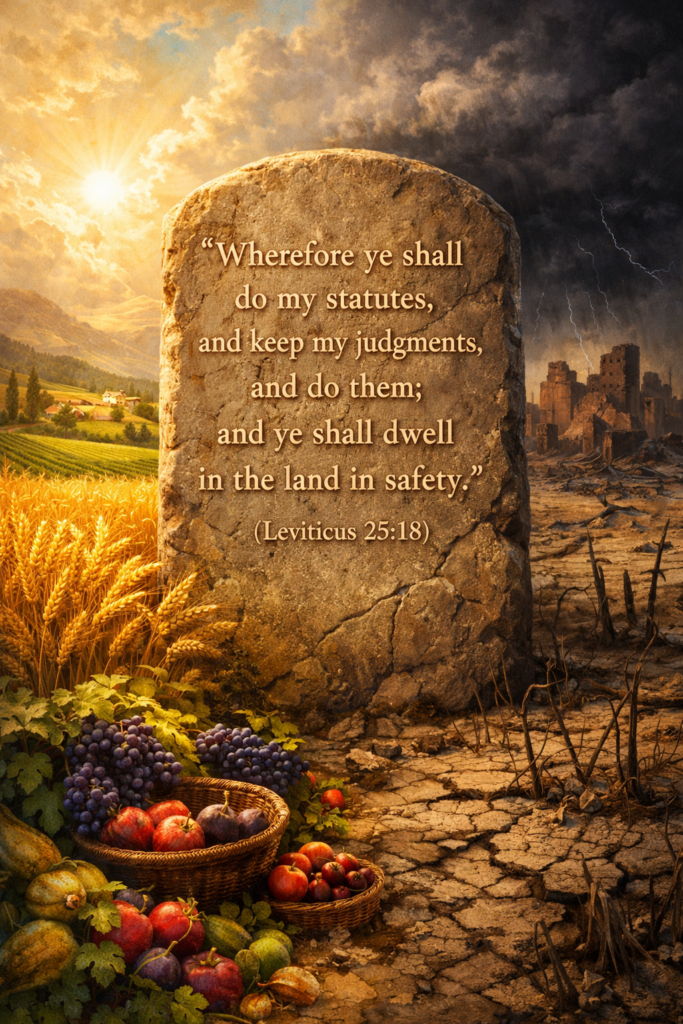
Leviticus 25:18 “Wherefore ye shall do my statutes, and keep my judgments, and do them; and ye shall dwell in the land in safety.”

The promise is wonderfully clear and direct: Walk in God’s statutes. Keep His judgments. Do them.

Then the result is safety, provision, and rest.

The passage immediately shows what obedience produces in everyday life: Leviticus 25:19 — “And the land shall yield her fruit, and ye shall eat your fill, and dwell therein in safety.” Leviticus 25:20–21 — “And if ye shall say, What shall we eat the seventh year? behold, we shall not sow, nor gather in our increase: Then I will command my blessing upon you in the sixth year, and it shall bring forth fruit for three years.”

God does not leave His people wondering how they will survive if they obey. He answers the practical question before they even ask it — and He answers it with a three-year supply so there is no room for doubt.

Yet the chapter — and the one that follows — also marks the other road with brutal honesty. When a people refuse to walk in His statutes, refuse to keep His judgments, refuse to do them, the consequences are not vague or distant. They are listed plainly:

  • Terror that comes suddenly
  • Consumption that wastes the body
  • The burning ague (fever) that consumes strength
  • Seed sown in vain
  • Enemies devouring the increase of the land
  • Sevenfold punishment when correction is ignored
  • Cities laid waste
  • Sanctuaries desolate
  • The land finally enjoying her sabbaths — while the people are carried away into exile

Leviticus 26:31–35 (KJV) “And I will make your cities waste, and bring your sanctuaries unto desolation… Then shall the land enjoy her sabbaths, as long as it lieth desolate… As long as it lieth desolate it shall rest; because it did not rest in your sabbaths, when ye dwelt upon it.”

The land will have its rest — one way or the other. Either you give it willingly in obedience, and God blesses you with abundance, or it takes its rest while you are removed, and everything is lost.

A Question for Today

We sometimes read these chapters and think, “That was only for ancient Israel.” But the principle remains: God still calls His people to walk in His ways — and He still warns what happens when we choose our own.

Is there any place where we quietly tell the Lord, “This command isn’t practical right now”? Where we adjust His instructions about honesty, generosity, rest, justice, or relationships because they feel too costly or inconvenient?

Every time we do, we are choosing which side of Leviticus 25–26 we want to live under:

  • The path of obedience that brings safety, fullness, and supernatural provision, or
  • The path of disobedience that brings terror, waste, and the land resting without us.

The Lord still speaks the same word: Leviticus 25:18 — “Wherefore ye shall do my statutes, and keep my judgments, and do them; and ye shall dwell in the land in safety.”

Stay in the Book,

Brother Tony

Wrong Dispensation for the Blasphemer, but the Perfect Double-Standard for Today’s Cancel Culture

Leviticus 24:16 (KJV)

“And he that blasphemeth the name of the LORD, he shall surely be put to death, and all the congregation shall certainly stone him: as well the stranger, as he that is born in the land, when he blasphemeth the name of the LORD, shall be put to death.”

No appeals. No “let’s pray about it.” No grace period. The whole congregation turned into an instant execution squad—every single person was expected to grab a rock and join in. Small group accountability night became a very literal group stoning.

His real crime? Being born on the wrong side of Calvary. One covenant later and he might’ve gotten mercy instead of mandatory participation in his own demise.

Fast-forward to today

The same crowd that calls Leviticus 24 “barbaric Old Testament justice” suddenly channels that exact same energy when canceling Christians. They dig up a 15-year-old post, declare it blasphemy against the current cultural creed, and the digital congregation assembles—ratioing, doxxing, mass-reporting, career-ending—all with Leviticus-level intensity: no grace, no appeals, full participation required. Old economy wrath, delivered at modern internet speed.

But when it’s one of their own caught in sin? Instant switch: New Covenant mode engaged.

“Judge not,” “let him who is without sin cast the first stone,” “we’re under grace now, not law.” Their sins (or their group’s sins) get covered with “nobody’s perfect,” “context matters,” “restoration takes time,” while the Christian who slips gets buried under full law-style condemnation.

It’s the ultimate covenant cosplay:

  • Old Testament severity when punishing outsiders.
  • New Testament mercy when shielding insiders.

Pick whichever economy makes you look righteous and the other guy look evil.

That’s why Galatians 6:1 is such a perfect reminder for us—both in real life and online:

Galatians 6:1 (KJV)

“Brethren, if a man be overtaken in a fault, ye which are spiritual, restore such an one in the spirit of meekness; considering thyself, lest thou also be tempted.”

Not expose. Not destroy. Not make an example. Restore. In meekness. While keeping a close watch on your own heart.

The sarcasm practically writes itself: We laugh (darkly) at how the Leviticus 24 crew turned judgment into a mandatory group project… but we’d better make sure we’re not running our own hypocritical version today—pulling out the stones of the old law when it feels good to punish others, then waving the banner of grace when it protects our side.

Galatians 6:1 isn’t optional for the new covenant community, whether the fault happened in the camp or in the comments section.

Stay in the book.

May we be people who apply grace consistently—starting with the person in the mirror.